

An app pay per click campaign is structured in three layers. Campaigns are split by goal: acquisition, re-engagement and brand defence. Ad groups are split by intent, platform and geography. Budget is split between proven and test lines. Bids then rise in stages, and each placement is judged on installs and in-app events, not clicks.
Why a pay per click campaign needs a different structure for apps
On the web, the click often lands where conversion happens. For an app, it is only an input: the user must still reach the store listing, install, open the app and act, so cheap clicks can hide users who never register or buy.
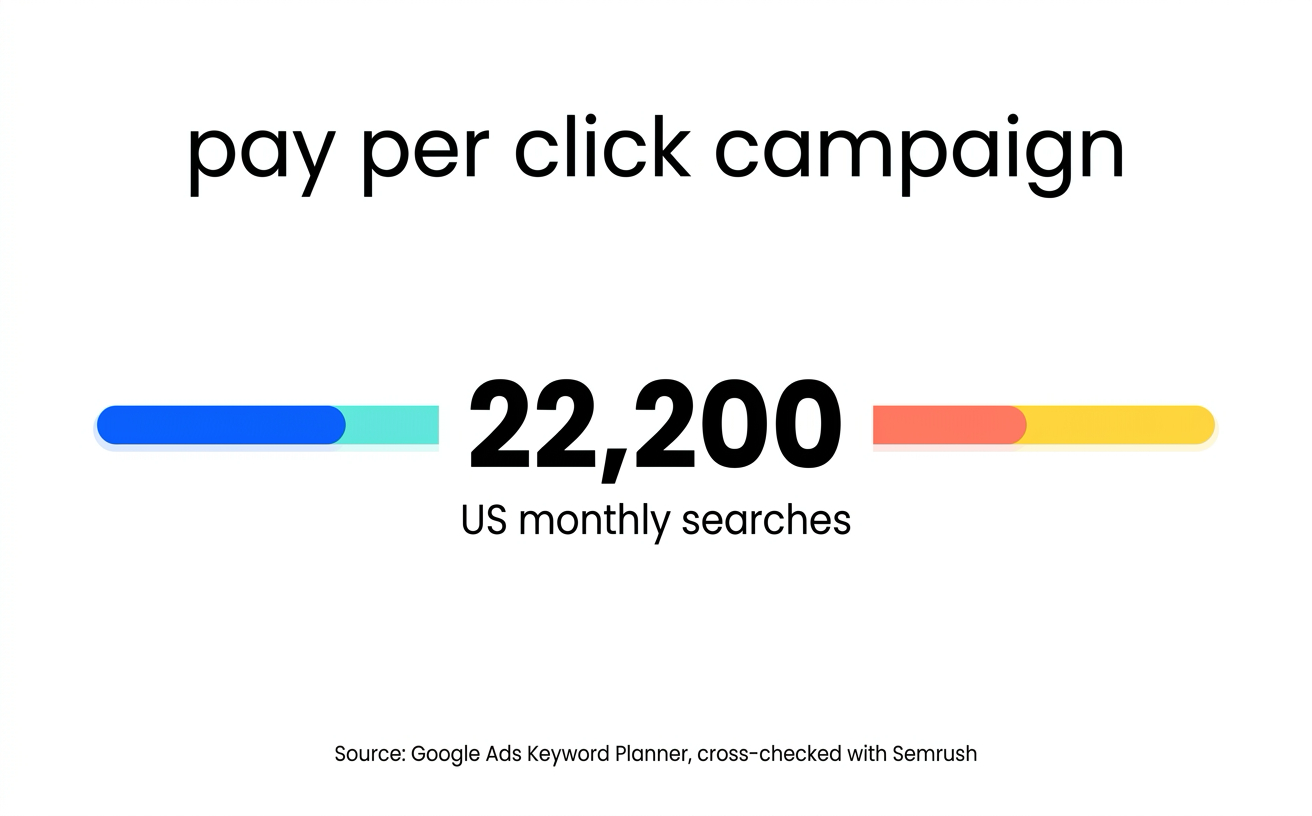
Demand for the topic is real but broad. In October 2026, "pay per click campaign" received 22,200 US monthly searches, according to Google Ads Keyword Planner (retrieved 11 October 2026) and Semrush (retrieved 13 October 2026). That figure describes broad search demand for the term, not app-only interest, which is why the structure below keeps app installs and in-app events at its centre.
How to structure a pay per click campaign for app growth
A sound ppc campaign structure separates campaigns by goal, each with its own budget and success measure:
- Acquisition campaigns pursue new installs.
- Re-engagement campaigns reach existing or lapsed users, judged on returning activity.
- Brand defence campaigns protect searches for your app's name, keeping that traffic from flattering acquisition results.
Inside each campaign, build ad groups by intent, platform and geography, so a weak segment can be paused without disturbing a working one. For search, a tool such as Google Ads Keyword Planner can suggest candidate terms; sorting them by intent is still your job.
Split budget into proven and test lines: proven ad groups carry most spend, while a capped test line funds new keywords, placements and creatives. Keep the store listing's message consistent with the ad group that sends users to it. Gadmobe's mobile performance advertising measurement guide recommends a decision log for every meaningful change, recording the hypothesis, the variable changed, the expected signal, the guardrail, the review date and the result. Applied to this structure, one entry per test line or ad-group change lets you interpret a change rather than treating all activity as one result.
Staged bidding: test, validate, scale
1. Test. Launch new segments with conservative bids and capped budgets. Decide upfront which in-app event, such as registration or first purchase, counts as quality and what you can pay for it.
2. Validate. Confirm results hold across enough time and volume to rule out noise. Cometly's PPC dashboard guide describes systematic A/B testing against conversion data. Pause segments that produce clicks without installs, or installs without the chosen event, until the next hypothesis is ready.
3. Scale. Raise bids and budgets on validated segments in measured steps, rechecking quality after each. If quality slips, revalidate.
Set these gates from your own unit economics and quality event, not universal thresholds.
Pause-or-scale matrix
Our editorial analysis, by campaign type:
| Campaign | Quality event | Warning signal | Action |
|---|---|---|---|
| Acquisition | Registration or first purchase | Installs rise, event flat | Pause or retest; scale once validated |
| Re-engagement | Returning activity | Clicks without resumed activity | Refine audience or creative first |
| Brand defence | App activity from brand searches | Spend rises, activity does not | Keep budget separate from acquisition |
Click-to-install quality checks
Review quality by placement, not just campaign:
- Click-to-install rate. A placement with many clicks and few installs deserves scrutiny. Compare it with sibling placements, not outside benchmarks.
- Install-to-event rate. Many installs with no downstream registrations or purchases are a warning sign.
- Invalid-traffic signals. Watch for sudden spikes from one source, odd timing or installs that never open. Monitoring can reduce exposure; it cannot eliminate fraud.
- Attribution prerequisites. Confirm installs and in-app events are recorded before spending at scale. Singular's PPC explainer covers how attribution modelling and conversion tracking connect PPC spend to mobile outcomes.
Privacy frameworks can limit user-level signals, so deterministic data may need combining with modelled insight; Gadmobe's guide to privacy-safe mobile app attribution explains the set-up. The same measurement guide keeps reporting, attribution and incrementality separate: an attributed install shows which campaign received credit, but whether that campaign added installs that would not otherwise have happened is a separate incrementality question.
In-house PPC or a managed mobile performance partner
In-house PPC works when your team can read attribution data, review placements and test without starving proven campaigns; a partner can add review and monitoring capacity. That comparison is a capacity decision: weigh regular placement review and experiment analysis against the cost and oversight of outside support.
Ask any partner how it tests, handles suspicious traffic and reports placement quality; distrust promised outcomes. Gadmobe's managed mobile performance advertising service is a commercial route for hands-on optimisation and quality controls, while its mobile app user acquisition service supports broader growth planning. Results are not guaranteed. See how Gadmobe works with app advertisers, or contact the Gadmobe team to discuss your campaign.
Pay per click campaign checklist for app advertisers
- Separate campaign goals; split ad groups by intent, platform and geography.
- Define the quality event and what you can pay for it.
- Confirm install and in-app event attribution works.
- Validate over enough time and volume before scaling.
- Review click-to-install and install-to-event rates by placement.
- Exclude suspicious placements; raise bids in steps.
- Log each meaningful change with its hypothesis, variable, expected signal, guardrail, review date and result.
FAQ
What is a pay per click campaign?
A pay per click campaign is advertising in which you pay each time someone clicks your ad. For apps, success is judged by the installs and in-app events that follow.
Cost per click vs cost per install: what's the difference?
CPC prices each click; CPI prices each install. A low CPC can still mean an expensive install if few clicks convert, which is why app install campaigns are judged beyond clicks. For CPI versus CPA, read Gadmobe's CPI vs CPA guide.
How should I set a test budget?
Keep a capped test line separate from proven activity, work back from what you can pay for your quality event, and judge the test on that event, not clicks.
When is a campaign ready to scale?
When a segment has passed validation on your quality event over meaningful volume and placement checks show no warning signs.