

Mobile performance advertising is the discipline of buying and optimizing mobile media against defined business outcomes, not simply producing more dashboard activity. A useful measurement approach connects campaign signals to a decision: continue, change, test, limit, or reallocate spend—while being honest about what each signal can and cannot prove.
What mobile performance advertising measures—and what it should not promise
A campaign report can show delivery, clicks, installs, registrations, purchases, or another agreed event. That visibility matters, but it is not a guarantee that a campaign caused every observed outcome. Privacy choices, consent requirements, platform policies, aggregation, and incomplete tracking can all change what is observable. The practical question is therefore not “Which metric looks best?” but “Which evidence is strong enough for this decision?”
Start by separating three layers. Reporting describes what happened in the platforms and analytics systems. Attribution assigns credit to a touchpoint under a defined model. Incrementality asks a different question: whether the activity created causal lift compared with an appropriate control. As Singular explains, attribution and incrementality are complementary rather than interchangeable. That distinction keeps a useful mobile app attribution report from being overstated as proof of business impact.
Set the decision system before launching campaigns
A decision system turns objectives into operating rules. Before launch, agree on the business outcome, the leading indicators worth watching, the attribution window, the reporting cadence, and the person who can approve a material budget change. Then define the action each result should trigger. For example, weak conversion quality may call for an audience or landing-path review; an inconclusive result may require more time or a better test design rather than a rushed scale decision.
Use a short decision log for every meaningful change: hypothesis, variable changed, expected signal, guardrail, review date, and result. This makes mobile ad performance measurement repeatable and prevents teams from retrospectively treating a coincidental movement as a win. It also gives agency and in-house stakeholders a shared record of why spend moved.
Build a measurement stack for mobile performance advertising
A measurement stack should make its limits visible. At a minimum, reconcile media-platform reporting with the mobile measurement partner, product or CRM events where relevant, and a business-facing view of the agreed outcome. Improvado’s overview of advertising analytics describes why modern marketing measurement commonly spans several systems rather than a single dashboard.
The operating detail is governance: consistent event definitions, campaign naming, ownership, access, and a clear refresh schedule. Without it, two reports can answer the same question differently. Claravine’s paid-media governance guidance highlights the risk of inconsistent tracking and decentralized data. Treat tool names as implementation choices, not endorsements; the right configuration depends on the app, markets, consent design, and reporting requirements.
Where AI-assisted optimization helps, and where human review remains necessary
AI-assisted features can help teams surface patterns, pace bids, cluster creative signals, or prioritize anomalies for review. They do not remove the need to define the objective, inspect data quality, or decide whether a recommendation fits brand, budget, and customer value. This is especially important where the available signal is partial or platform-dependent.
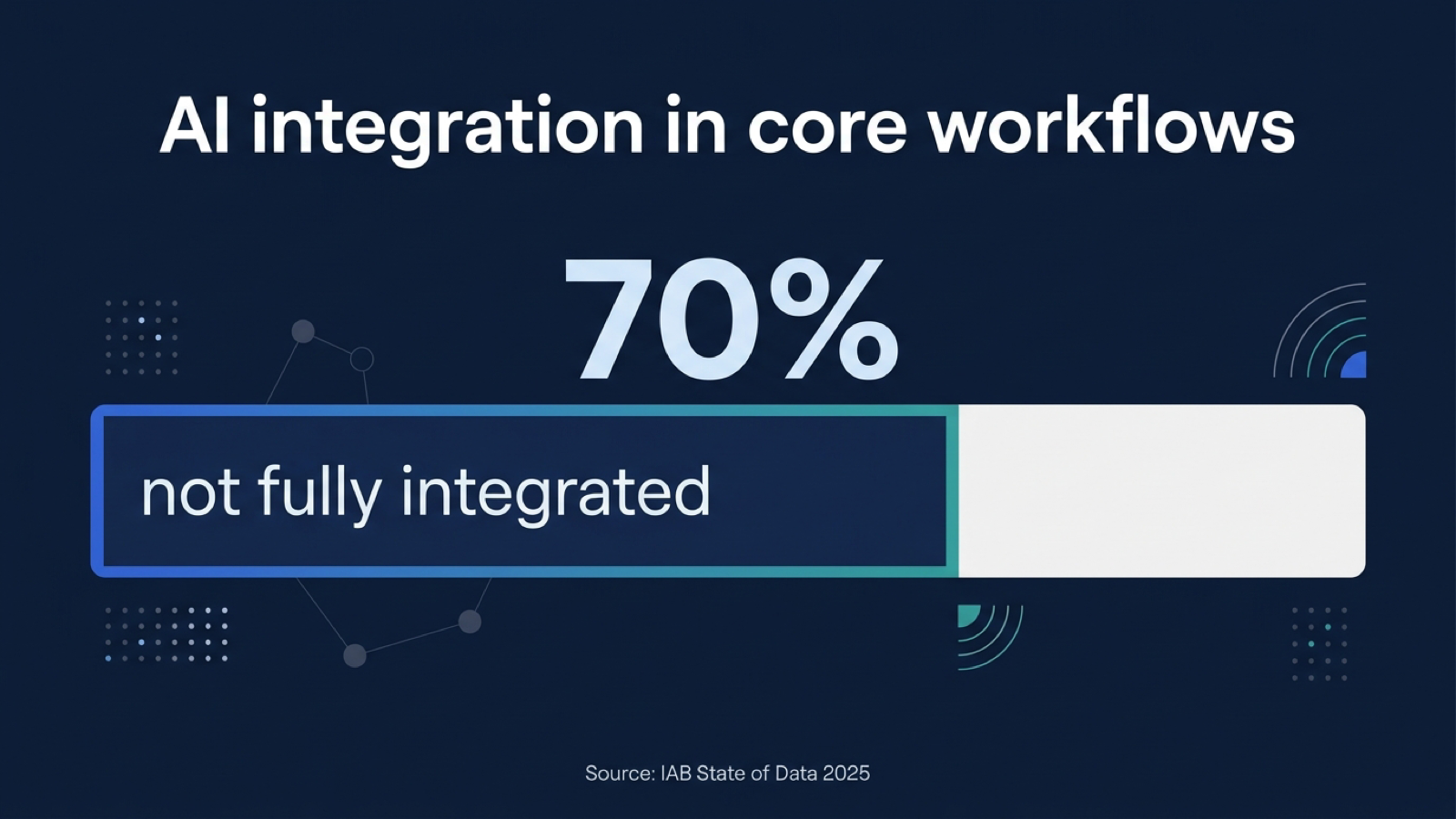
IAB’s *State of Data 2025* reported that 70% of marketers had not fully integrated AI into core workflows. That is a useful adoption-context statistic, not a prediction of campaign results or a mandate to automate every decision. Read the IAB report.
> Infographic — 70% of marketers have not fully integrated AI into core workflows.
>
> Suggested visual: a single 70% proportion bar with a clear “not fully integrated” label, source line, and no performance implication. Source: IAB, *State of Data 2025* (published March 2025; reviewed August 18, 2026).
Human review should remain explicit for material reallocations, outlier diagnosis, creative claims, and any decision affected by changing privacy or regulatory requirements. Requirements can vary by jurisdiction and platform; obtain appropriate legal and privacy review instead of inferring compliance from a tool setting.
Test, learn, and reallocate without mistaking attribution for incrementality
Creative and audience tests work best when they answer one planned question at a time. State the hypothesis, isolate the variable where feasible, agree the success and stop conditions, and retain a record of the context. Admiral Media’s creative-testing framework similarly frames testing as a repeatable process rather than a sequence of disconnected experiments.
For higher-stakes budget decisions, add an incrementality design when practical. Controlled test-and-control approaches can help estimate causal lift; Remerge’s explanation outlines why this differs from modelled attribution. Feasibility depends on volume, geography, platform controls, and experimental design, so an incrementality test is not automatically available or definitive. Use it to challenge attribution-led conclusions, not to replace ordinary campaign reporting.
When to use a managed mobile performance advertising partner
A partner can be valuable when the internal team needs disciplined measurement operations alongside media execution: shared decision rules, quality controls, testing cadence, and clear reporting responsibilities. The right question is not whether an external team can promise a result; it is whether the operating model will give stakeholders better evidence for the decisions they must make.
Gadmobe supports advertisers seeking hands-on mobile campaign execution through its mobile performance advertising service. Teams evaluating their acquisition operating model can also explore mobile app user acquisition and Gadmobe’s advertiser solutions. For channel-planning context, see the related guide to mobile performance advertising channel mix.
Mobile performance advertising measurement checklist
- Define the business outcome and the decision each metric will inform.
- Document event definitions, attribution assumptions, and data-quality owners.
- Schedule hypothesis-led creative and audience tests with guardrails.
- Review automated recommendations against context, customer quality, and platform limits.
- Use incrementality methods where the decision size and test conditions justify them.
- Reallocate only when the evidence meets the standard agreed before launch.
The result is not perfect measurement. It is a defensible, repeatable way to make mobile performance advertising decisions with the evidence available—and to know when more evidence is needed.