

Mobile app attribution is no longer a matter of selecting one dashboard and treating every install as a definitive answer. App-growth teams need a measurement design that works with platform privacy models, allows for aggregation and uncertainty, and still supports practical media decisions.
Here, “privacy-safe” describes a measurement-design approach that accounts for privacy-preserving platform frameworks. It is not legal certification, a compliance conclusion, or a promise of complete visibility. A practical operating model connects first-party events, platform-native measurement, a mobile measurement partner (MMP) where appropriate, and reporting that makes discrepancies visible. That gives teams a governed way to use mobile app tracking attribution rather than simply compare competing network reports.
What changed in mobile app attribution?
Apple and Google have distinct approaches, so teams should not treat privacy-preserving measurement as one universal feature set. On iOS, Apple’s AdAttributionKit documentation describes attribution for app installations and re-engagements without tracking individual users. Postback detail can vary according to crowd-anonymity thresholds, so reporting granularity can differ by campaign.
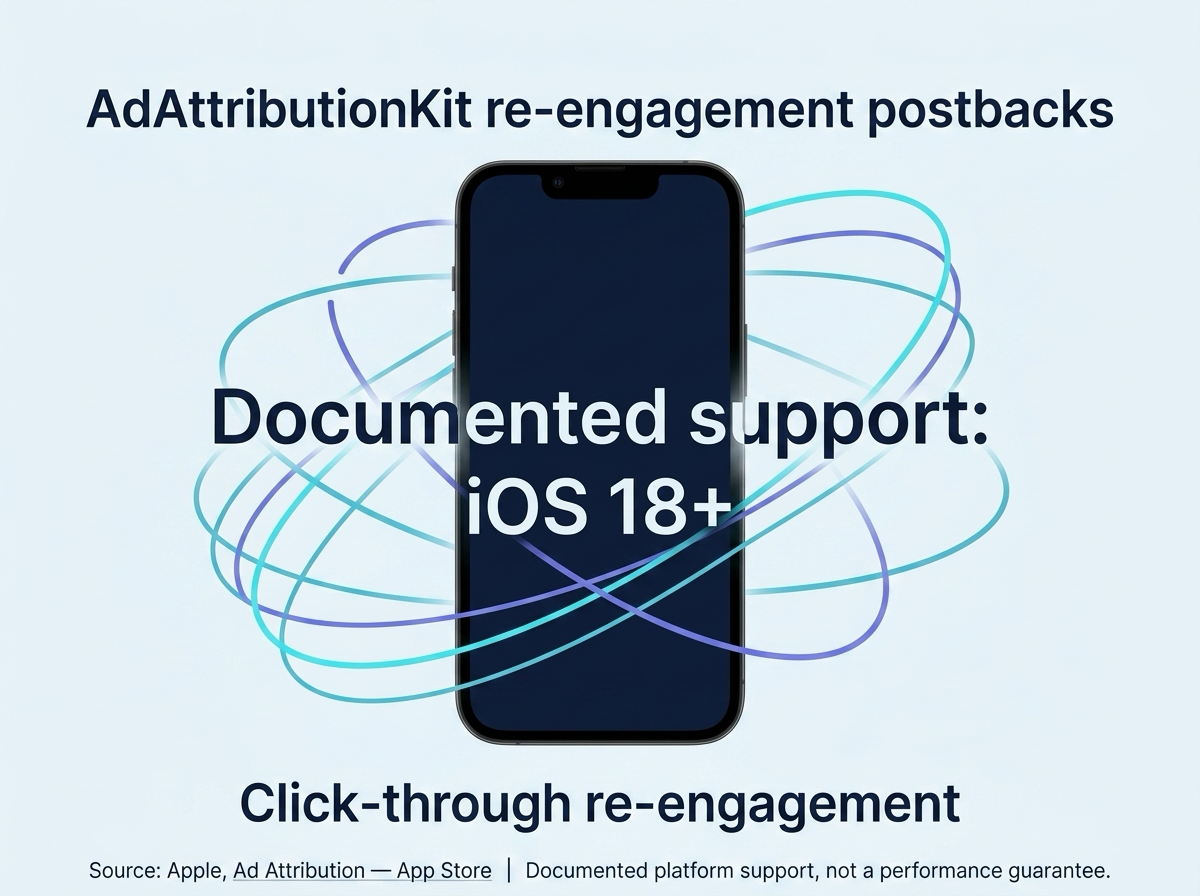
Apple also documents click-through re-engagement information in iOS 18 and later. That is documented platform support, not a promise that every traffic source, implementation, or campaign will produce comparable signals.
For Android, Google describes the Attribution Reporting API as a separate privacy-preserving approach to advertising measurement. Treat its implementation and reporting behavior as Android-specific; do not carry iOS assumptions into Android planning, or the reverse.
The practical question for a growth lead is not “which dashboard is right?” It is which decisions need campaign-level attribution, which can use aggregated evidence, and which require an experiment or incrementality test before a budget move.
Build a privacy-safe mobile app attribution architecture
Start with business events rather than a vendor shortlist. Define a compact event taxonomy that connects acquisition to actions the team can act on: install, registration, trial start, first purchase, subscription renewal, or another meaningful activation. Give each event a definition, owner, and QA rule. If teams define “activation” differently, a mobile app attribution tool cannot repair reporting later.
Then map where each signal starts and where it is used:
1. First-party event layer: Document event definitions, consent-dependent collection, app versions, and data owners.
2. Platform measurement layer: Implement and validate Apple and Android requirements separately.
3. MMP layer: An MMP may support integration coordination, event governance, and reporting workflows when it fits the stack. Adjust’s MMP guide presents a single-source-of-truth role as vendor guidance; assess that framing against the actual network mix and internal definitions.
4. Reporting layer: Create a decision view that shows source, methodology, time window, and known limitations—not only a blended total.
Consent, retention, and data-processing obligations vary by jurisdiction, product design, and the parties involved. Appropriate legal and privacy owners should review the implementation. Neither a tool choice nor an exploratory Gadmobe consultation establishes compliance with every applicable law.
How to evaluate a mobile app attribution tool
The best attribution software for mobile apps is rarely the product with the longest feature list. It is the option the team can implement, understand, and govern. Evaluate candidates with six questions:
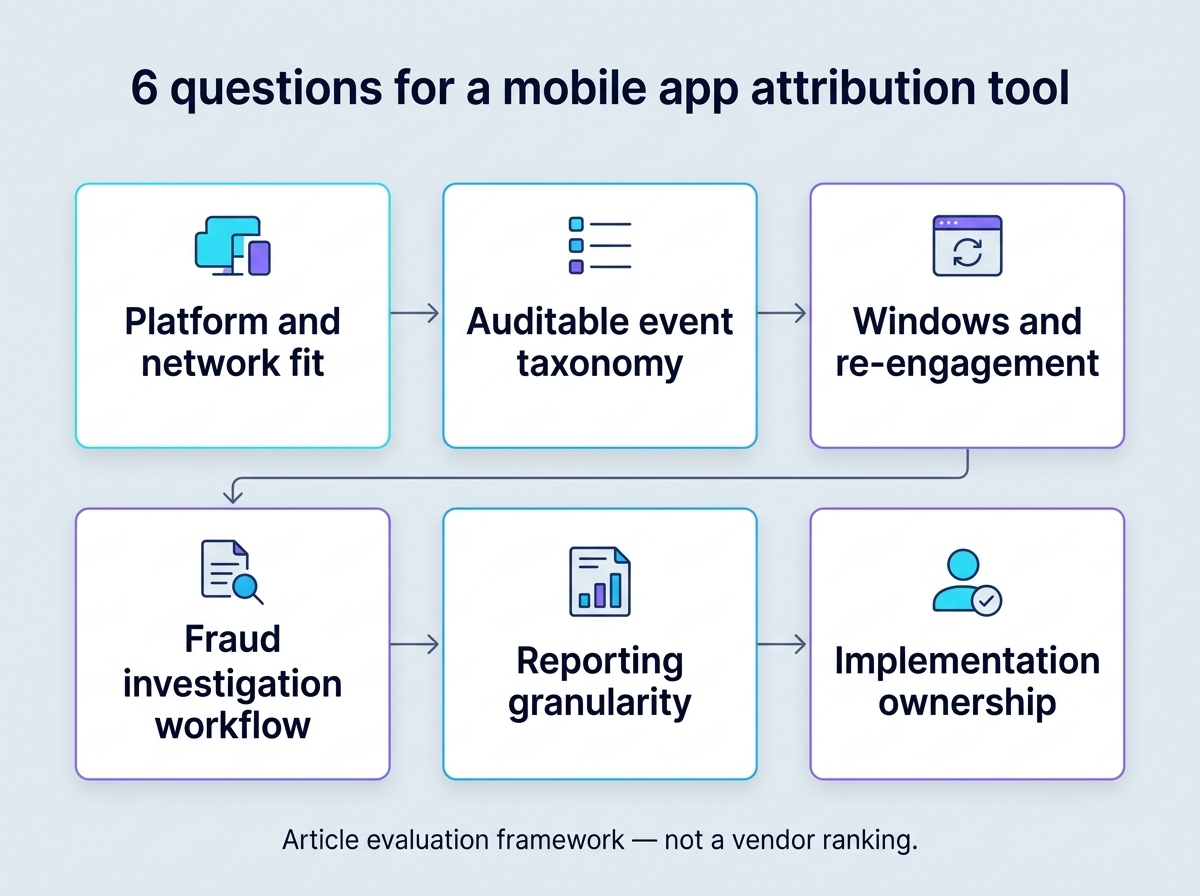
- Does it support the platform APIs and network integrations in the actual media plan?
- Can it maintain a consistent event taxonomy and make changes auditable?
- How are attribution windows, re-engagement, and reporting cutoffs handled?
- What fraud controls and investigation workflows are available, and what remains the team’s responsibility?
- Can finance, analytics, and UA stakeholders inspect reporting granularity and methodology?
- Who owns implementation, QA, access management, and reconciliation after launch?
Vendor material is an implementation signal, not a universal benchmark. Google Privacy Sandbox’s AppsFlyer and Unity Ads case study describes live-traffic testing, noisier data, and new aggregation methods in that implementation. Use the example to ask technical questions about a specific stack, rather than to infer an outcome elsewhere.
Operate the measurement loop, not just the setup
Set decision rights before the first performance review. Define the dashboard used for daily pacing, the source used for finance reconciliation, and the discrepancy that triggers investigation. Apple notes in its MMP guidance that reporting can differ because of methodology, including install versus first open and attribution windows. A mismatch is a QA prompt, not automatic proof that one source is wrong.
Run a recurring checklist: test event firing after releases; confirm campaign links and network mappings; review consent-related behavior; reconcile platform, MMP, and internal totals; and record changed windows or definitions. Where attribution is not granular enough for a budget decision, use aggregated analysis, a feasible holdout, or another incrementality design alongside it.
A 30-day attribution readiness checklist
In week one, inventory events, media partners, owners, and reporting conflicts. In week two, document iOS and Android requirements separately and schedule consent and data-governance review. In week three, configure integrations, test events, and write reconciliation rules. In week four, run controlled QA, train decision-makers on limitations, and schedule the first measurement review.
Gadmobe’s mobile app user acquisition, mobile performance advertising, and advertiser solutions pages are starting points for teams assessing their acquisition operating model. A consultation can explore attribution architecture, implementation ownership, QA priorities, and reporting governance without presuming a particular technology or compliance outcome.
Mobile app attribution in 2026 is not a promise of perfect visibility. It is a transparent, privacy-safe system for making the next growth decision with clearer evidence.