

A mobile game user acquisition tool can be a measurement product, activation platform, creative-testing workflow or managed partner. The right choice is not the stack with the most features. It is the stack that gives a team usable evidence for its next campaign decision, with responsibilities and implementation work it can sustain.
Why tool selection is now a measurement and operating decision
A dashboard is not a single source of truth. When evaluating a mobile game user acquisition tool, ask how measurement signals will be interpreted together before judging its interface. Affise’s MMP selection guide is a starting point for measurement and integration questions; it does not replace a technical or governance review.
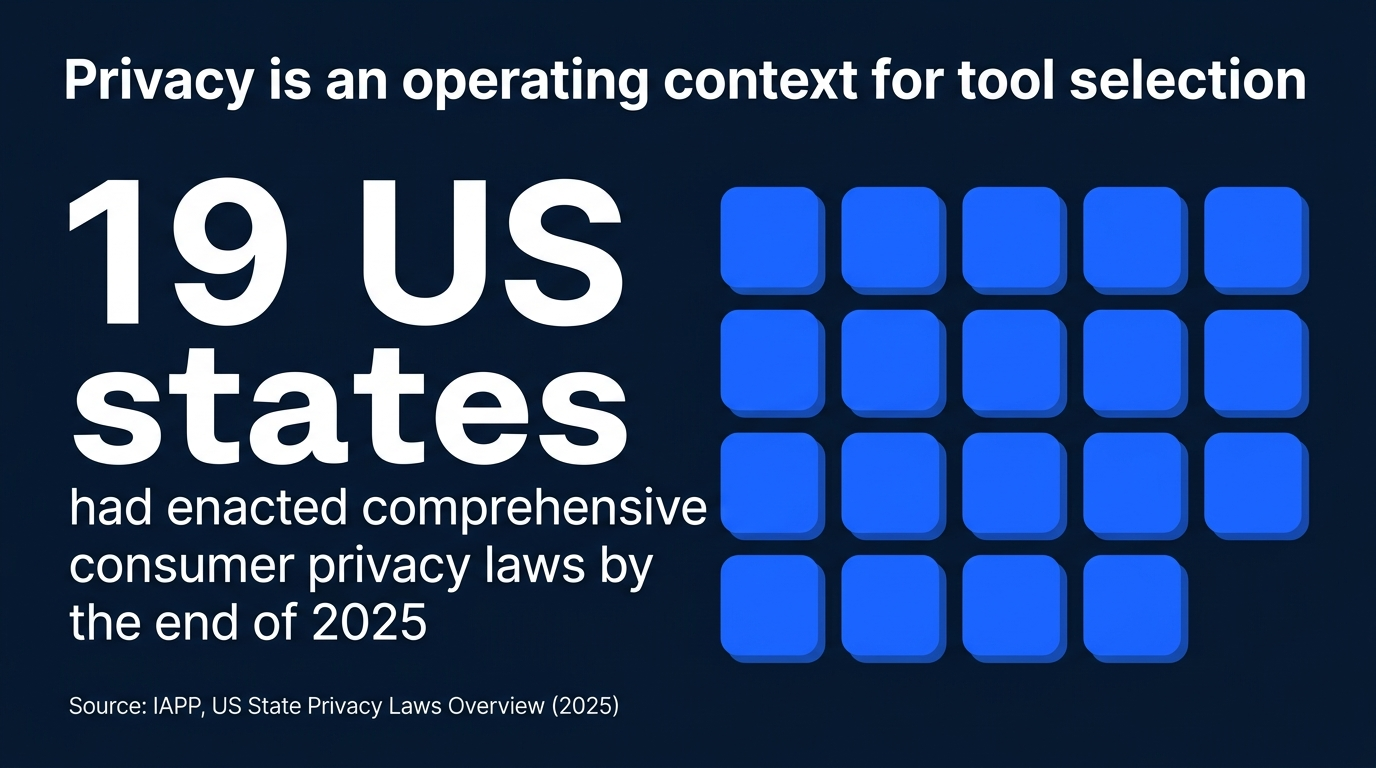
Data governance belongs in the buying conversation. The International Association of Privacy Professionals reported that 19 US states had enacted comprehensive consumer privacy laws by the end of 2025. This jurisdiction-dependent statistic is not a compliance assessment; involve appropriate legal and governance owners in data decisions.
*Infographic source: IAPP, US State Privacy Laws Overview, published 2025-10-01; carried in the research brief on 2026-08-26.*
Start with the game-growth decision you need to make
Before comparing options, specify the decisions the stack must support: which channel merits another test, which creative hypothesis to scale, whether install evidence can inform budget allocation, and who owns the next action. That prevents a team from buying reporting volume without a decision cadence.
Separate the categories: a measurement partner may organise reporting, a network may supply inventory, and a creative workflow may speed testing. Read Gadmobe’s mobile game user-acquisition strategy focused on player value for the strategic foundation. This article focuses on tool and partner selection.
The five evaluation areas for mobile game user acquisition tools
1. Measurement and reporting that support a decision
Ask to see the reporting view used in a budget review. Can the team reconcile inputs with attribution evidence, explain gaps and document uncertainty? A large metric library is not proof that a decision is sound. Admiral Media’s mobile app user acquisition guide provides adjacent context.
2. Inventory, quality controls and fraud-risk visibility
Evaluate traffic-quality signals, the escalation route and the investigation owner. Ask what is reported when an anomaly appears and what evidence supports the supplier’s process. Avoid treating any option as fraud-free. Questions about click injection and SDK spoofing can test proposed controls; Cometly’s fraud-detection guide explains why these vectors merit scrutiny.
3. Creative-testing workflow and learning speed
A stack should turn a game insight into a documented test and preserve its hypothesis. Inspect approvals, reporting latency and the learning archive—not just a creative library. Admove.ai’s ad-testing guide offers context on workflows. The objective is repeatable learning, not a promised winner.
4. Campaign operations, support and accountability
Clarify who owns setup, pacing, reporting and incident response. A self-serve product can suit a capable team; a managed partner may suit one needing defined support and accountability. Review service scope and decision rights before data becomes difficult to interpret.
5. Integration, data governance and implementation burden
Map work across analytics, creative and legal or privacy stakeholders. Review data flows, access controls, ownership and maintenance effort. Solutionara’s overview of data-integration challenges shows why integration is an operating constraint. Treat mobile game attribution terminology as an implementation-review topic, not a legal conclusion.
A practical scorecard for comparing tools and partners
Use the same scorecard for every option. Give each row a 1–5 rating and record the evidence behind it:
| Evaluation area | Decision it must improve | Evidence to request |
|---|---|---|
| Measurement | Where to allocate the next test budget | Sample reporting, definitions and limitations |
| Quality controls | Whether traffic needs investigation or action | Control descriptions, alerts and escalation ownership |
| Creative workflow | What hypothesis to test next | Test process, approvals and learning archive |
| Operations | Who acts when performance changes | Service scope, cadence and named responsibilities |
| Integration | Whether the stack is sustainable | Data-flow map, implementation plan and governance owners |
Weight rows according to the game’s actual constraint. Compare evidence rather than sales-language confidence, and record questions unresolved after a demo.
Common selection mistakes that create false confidence
Do not treat a demo as implementation proof, let a feature checklist replace a measurement plan, or assign quality control to “the tool” without a named owner. Before selecting a partner, agree the optimisation decision, the evidence needed to inform it, and the review rhythm. For a complementary channel-level framework, see how to evaluate a mobile advertising network.
Do not collapse categories into one procurement decision. A network does not necessarily solve a reporting gap, and a reporting product does not necessarily provide operating support.
Build a tool stack around a measurable acquisition plan
The best mobile game user acquisition tool helps a team make a defensible next decision without creating unmanageable integration, reporting or accountability debt. Start with the objective, score options, and run a documented implementation review.
If you want to explore how a defined acquisition objective could be evaluated, start with Gadmobe’s mobile app user-acquisition service and advertiser solutions. An exploratory consultation can clarify the decisions, evidence and responsibilities to examine for a next campaign phase; it is not a performance guarantee.