
OEM app advertising means buying placements that Android device makers control, such as dynamic preloads at device setup, app suggestions, OEM app store slots and push notifications. It is one channel within a broader Android UA plan, suited to teams already running search, social and network campaigns who want more Android volume, particularly for launches in Android-dominant markets.
What counts as OEM app advertising
Device makers sell placements at three points on an Android phone: setup (preloads and app suggestions), their own app stores (featuring and search) and the device itself (push, splash and lock screens). Labels vary by OEM, so confirm each partner's definitions before comparing quotes. Avow, an OEM advertising vendor, names Splash, Push and Lock Screen as core media placements.
Two are often confused:
| Format | What happens | What it is not |
|---|---|---|
| Dynamic preload | Business of Apps: "Dynamic preloads place apps onto new devices but only install them when a user opts in during setup." | Not a forced install |
| Suggestion | A recommendation slot that shows your app to the user | Not an installed app; the user still chooses whether to install |
Why OEM placements are on 2026 UA plans
OEM placements reach users at moments search and social do not: device setup, the OEM's own store and the phone's system surfaces. That makes OEM a channel to evaluate against your existing Android mix, not a default budget line.
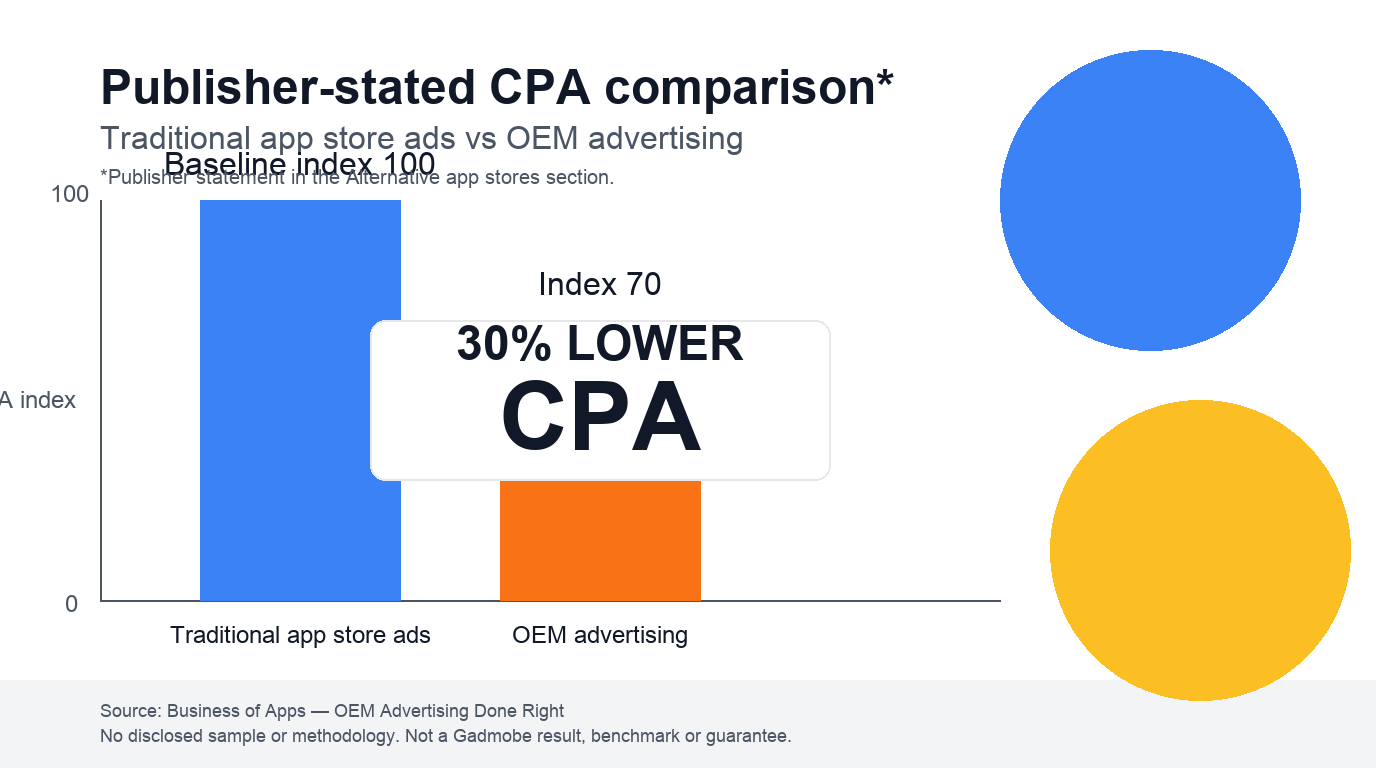
In the alternative app stores section of its guide to OEM advertising, Business of Apps states: "A 30% lower CPA compared to traditional app store ads." Read it narrowly. It is a publisher statement, with no disclosed sample or methodology. The comparison is only to traditional app store ads, not to search, social or network campaigns, and not to every OEM placement type. It is not a Gadmobe result, benchmark, or guarantee. Summaries that restate it as a saving against "traditional channels" overstate it.
The chart below restates that publisher statement as an index: traditional app store ads at 100, OEM advertising at 70.
*Publisher-stated comparison, not a Gadmobe result or benchmark; Business of Apps lists 30% lower CPA compared with traditional app store ads, with no disclosed sample or methodology; it does not cover all channels.*
Matching OEM placement types to your campaign goal
This matrix is operator analysis, not a market standard or a Gadmobe case study.
| Placement | User moment | Typical goal | Primary KPI | Main risk |
|---|---|---|---|---|
| Dynamic preload | New-device setup; installs only on opt-in | Launch volume in new-device cohorts | Cost per opted-in first open | Opt-in installs never opened; late attribution |
| Suggestion slot | App shown as a recommendation | Discovery | Cost per install, then registration | Low-intent taps |
| In-store featuring or search | Active browsing in the OEM store | Store visibility | Cost per registration or CPA | Thin placement-level reporting |
| Push notification | Everyday phone use | Re-engagement: Business of Apps says push notifications "can retarget users who installed but haven’t converted" | Cost per re-activated user | Consent handling, user fatigue |
| Splash or lock screen | Everyday phone use | Reach and new installs | Cost per downstream event | Accidental taps, intrusiveness |
Only push is a re-engagement tool here; judge splash and lock-screen as acquisition, and every row on downstream events.
Where OEM fits, and where it does not
Addict Mobile calls OEM "a relevant option for international launches in Android-dominant markets." OEM placements can suit campaigns that advertise Android app installs where Android carries most of the audience. In iOS-heavy markets, treat OEM as a limited add-on, never a replacement.
Either way, treat OEM as one line in your Android acquisition plan, judged on the same downstream events as your search, social and network campaigns. Planning that wider mix? See our mobile app user acquisition services.
Finance, crypto, gambling, iGaming and other regulated apps should confirm local advertising requirements and the relevant OEM's ad policy before testing, particularly for preload, lock-screen and push units.
How OEM inventory is bought and priced
Confirm terms with each partner first:
| Question to ask | Why it matters |
|---|---|
| Pricing model: CPI, CPA, another performance model, or a fixed fee? | Sets who carries quality risk |
| What is billable: a download, an opted-in preload, a first open, or an MMP-attributed install? | Preload and suggestion installs can be counted differently |
| Are there minimum spends, commitment periods or make-goods? | Determines how cheaply you can stop |
| Reporting cadence and placement detail? | Decides whether you can read the test |
Our guide on how CPI and CPA pricing differ covers the trade-offs. For channel-level context, see our performance-based mobile advertising page.
Quality and measurement checks before you scale
| Check | What to ask or compare |
|---|---|
| Attribution path | How preload, suggestion and push activity reaches your MMP, and how late first opens are attributed |
| Install-to-first-open lag | Track it by placement; question unusual patterns |
| Post-install events | Registration, retention and purchase rates against other Android channels, by cohort |
| Placement transparency | Reporting by placement and device model, not a blended total |
| Fraud controls | The partner's filtering, plus your own anti-fraud checks |
| Consent and policy | Consent handling for push and lock-screen units, and fit with your privacy obligations and the OEM's ad policy |
Designing a first OEM test
Keep a first Android OEM user acquisition test narrow so the result is readable, and agree every threshold with finance before launch.
| Test element | Narrow setting | Kill or pause criterion |
|---|---|---|
| Market | One Android-dominant market | Stop if volume is too small to read |
| Placement | One matrix row | No additions mid-test |
| Primary KPI | One downstream event | Pause if cost per KPI stays above target after the agreed learning window |
| Control | An existing Android channel, same market and period | Pause if first-open or downstream rates trail the control |
| Reporting | Placement and device-model level | Stop if this reporting is unavailable |
| Scale rule | Several cohorts | Scale only when the KPI holds across them |
A test that holds up earns OEM a place in your Android channel mix.
Learn how we support advertisers at Gadmobe advertiser solutions. For a second opinion on your channel mix, talk to Gadmobe about your Android acquisition plan.
FAQ
Is OEM advertising only for Android?
This guide covers Android device-maker placements. Plan iOS reach through available campaign channels.
How fast can a test go live?
Ask for a timeline up front that covers partner onboarding, creative approval and tracking setup.
Can regulated apps run OEM campaigns?
Possibly, but confirm local rules and the specific OEM's ad policy first.