

Mobile performance advertising is the practice of buying and optimizing app-growth media against a defined business result—not simply delivery signals such as clicks or installs. A credible evaluation connects the campaign event, its cost, attribution method and post-install quality before budget is scaled.
For growth teams, the point is not to discard delivery metrics. Click-through rate, installs and reach can help diagnose what happened in a campaign. The decision question is whether those signals lead to the customer behavior the business actually values: a qualified registration, subscription, purchase or another agreed event. That is the practical lens for evaluating mobile performance advertising.
Why delivery metrics alone do not show acquisition quality
A low cost per click or install can look efficient while obscuring weak downstream behavior. Outcomes-based measurement instead connects media activity to a business result; examples can include installs, registrations, subscriptions and purchases, depending on the objective. Kochava’s definition of outcomes-based measurement provides a useful starting point: agree what counts as the outcome before comparing channels, partners or creatives.

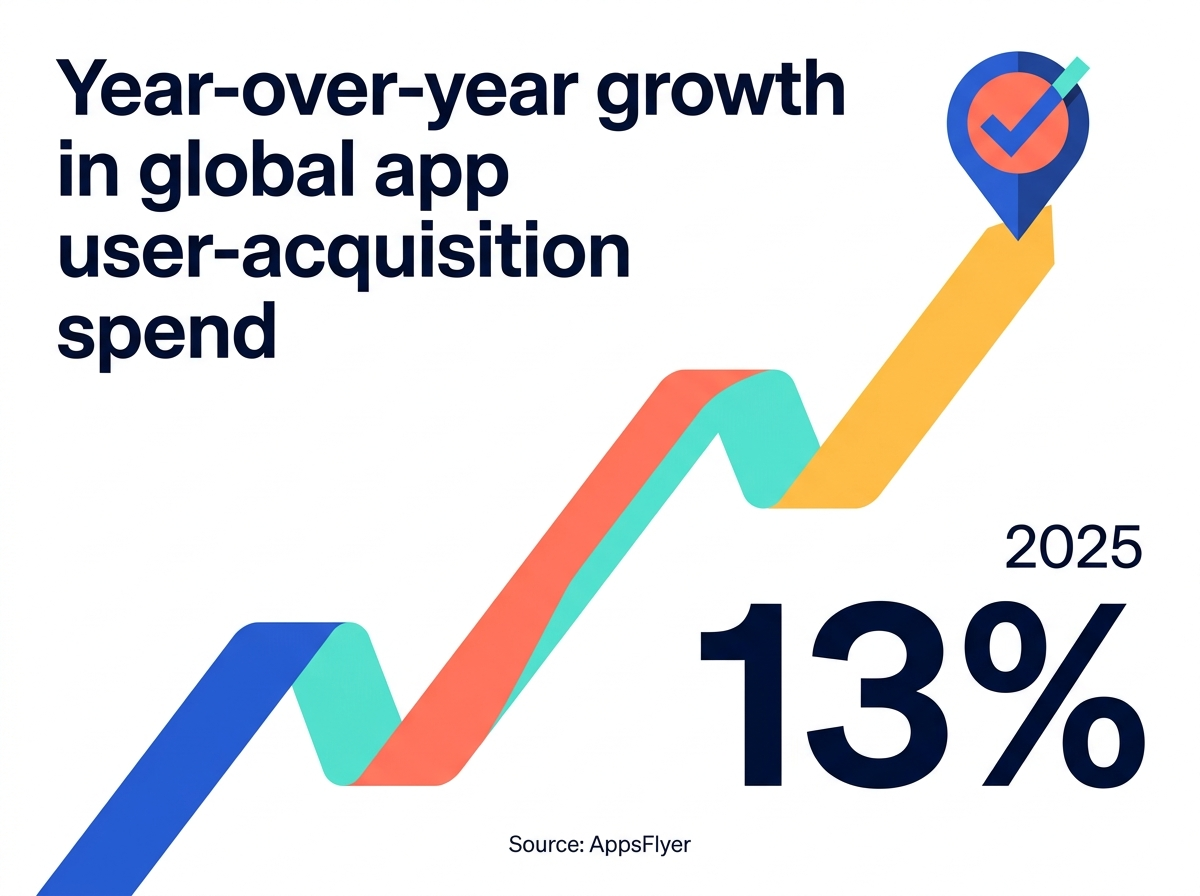
The scale of the decision makes that discipline more important. AppsFlyer reports global app user-acquisition spend of $78 billion in 2025, up 13% year over year. It is global market context—not a US forecast or a Gadmobe campaign result—but it reinforces why delivery-only reporting is not enough when acquisition investment grows. AppsFlyer’s 2026 trend report is the source for both figures.
The outcome-measurement framework for mobile performance advertising
Align the campaign event with the business objective
Start with the operating decision, not the media format. A subscription product may prioritize a completed trial with an early retention signal; a commerce app may use a purchase event; a marketplace may care about a verified first transaction. Document the event definition, qualification rules and the point at which it is mature enough to guide spend. That prevents an inexpensive but low-quality action from becoming the optimization target.
Connect cost, quality and post-install behavior
Use a simple chain: spend → attributed event → qualified user behavior → commercial outcome. Cost per outcome helps compare the price of the agreed event, while ROAS evaluates revenue attributed to ad spend. ROI is broader: it considers the overall return relative to investment, not just advertising efficiency. Both need business-specific context, and neither should be presented as a universal benchmark.
For mobile marketing measurement, pair near-term efficiency with longer-horizon quality. Moburst’s guidance on mobile marketing ROI recommends connecting acquisition cost to downstream value and using windows that fit the monetization model. Day 7, Day 30 and Day 90 views can answer different questions; a single-day reading can be misleading for apps whose value arrives later.
Define attribution and reporting cadence before launch
Agree the attribution source, event mapping, reporting owner and review cadence before the first budget decision. Mobile measurement partners can help attribute installs and post-install events across networks, but their interpretation is not frictionless. Privacy and platform changes, including Apple ATT and SKAdNetwork, can constrain device-level visibility and change what can be observed. Treat attribution as decision support with documented limits, not as proof of perfect causality.
Questions to ask a managed mobile performance advertising partner
Use these questions to turn a proposal into an evaluable operating plan:
- Which business event will be optimized, and how is a qualified event defined?
- What attribution source, measurement window and reporting cadence will be used?
- How will the team distinguish delivery performance from post-install quality?
- What evidence would trigger a creative test, channel reallocation or a measurement audit?
- Which results are observable on the relevant platform, and which are limited by privacy or attribution rules?
Clear answers make it easier to compare a managed service on process and measurement design rather than on a headline promise.
When to optimize the campaign, creative or measurement setup
First check whether the signal is trustworthy. If an event is missing, inconsistently mapped or reported on an unsuitable window, repair measurement before interpreting a channel as a winner or loser. If attribution is stable but a creative receives attention without qualified events, test the message, audience or landing experience. If qualified outcomes are present but costs differ materially by channel, review allocation against the agreed economics.
Optimization should be continuous and documented. Branch’s mobile advertising analytics guidance describes a test-and-learn approach that reviews performance against clear targets and reallocates based on current data. It does not guarantee that a change will improve outcomes; it gives teams a repeatable way to decide what to test next.
Put the framework into practice with a managed campaign
Gadmobe helps app-growth teams translate objectives into a scoped mobile performance advertising plan: the event to optimize, the available measurement inputs, the reporting rhythm and the optimization process. That is a more useful starting point than treating a click or install price as the whole result.
If you are assessing a new campaign or reviewing an existing one, begin with the objective, event taxonomy and attribution constraints. Then bring the framework into a conversation with Gadmobe or contact the team to discuss managed execution suited to your market, platform and measurement setup. Outcomes will vary by product, audience, platform policy, attribution coverage and commercial model.