

Mobile app marketing is no longer a channel checklist. Growth teams need a connected operating plan that ties measurement, audiences, creative and partner accountability to the business outcome that matters next. That is especially important when privacy choices, platform rules and app categories can change what is measurable.
This guide is for teams building a practical mobile user acquisition strategy—not a promise that one channel, format or tool will produce a universal result. The right mix depends on the app, market, audience, lifecycle stage and quality of available data.
What mobile app marketing covers—and where user acquisition fits
Mobile app marketing spans the lifecycle: defining an audience and proposition, creating demand, acquiring users, understanding early in-app behavior and improving retention. User acquisition is the paid and partner-led acquisition layer within that system, not the whole strategy. A useful plan makes the handoffs explicit: which event signals a meaningful install, who owns creative learning, and how acquisition feedback changes the next test.
Teams that need managed execution can explore Gadmobe's mobile app user acquisition services. The strategic work should still come first: a service partner can execute better when success criteria and decision rights are clear.
Start with a measurement plan before choosing channels
Begin with the decisions the programme must support. For example: which audience hypothesis deserves more budget, which onboarding action indicates quality, and when should a campaign be paused? Map each decision to a measurable event, an owner, a reporting cadence and a limitation. A formal measurement framework is particularly important in a privacy-conscious environment, as INCRMNTAL's measurement guide explains.
Where campaigns span more than one paid source, teams often use a mobile measurement partner to help establish a more consistent attribution view. This does not make attribution perfect: consent choices, privacy settings, modeled results and platform rules can limit what is observable. Establish the attribution approach before comparing channels, and document how deduplication, reporting windows and incrementality questions will be handled.
Build a multi-platform acquisition mix around audience and funnel role
A multi-platform marketing plan should assign each channel a job rather than duplicate the same spend everywhere. One channel may test broad discovery, another may reach a high-intent audience, while owned surfaces help bring evaluators back to the app's proposition. The objective is a coherent customer journey, not maximal platform count.
That direction reflects a shift from a narrowly mobile-first approach toward connected, multi-platform journeys described in Adjust's 2026 market outlook. Start with a small number of testable channel roles, define the quality signal for each and compare results using the same measurement rules. Geography, category restrictions, audience-data permissions and platform policies can materially change the appropriate mix, so retain room to adapt.
For teams seeking campaign execution across relevant channels, mobile performance advertising should be evaluated as a managed discipline: measurement requirements, quality controls, creative process and reporting transparency matter as much as media access.
Use current creative formats to improve learning quality, not to promise performance
Creative is an experiment design problem. Build a testing backlog around one clear variable at a time—such as value proposition, product moment, audience context or call to action—then define the threshold for learning before launch. A documented testing structure helps prevent spend from being mistaken for insight; RocketShip HQ's creative-testing guidance is a useful platform-specific example of the underlying discipline.
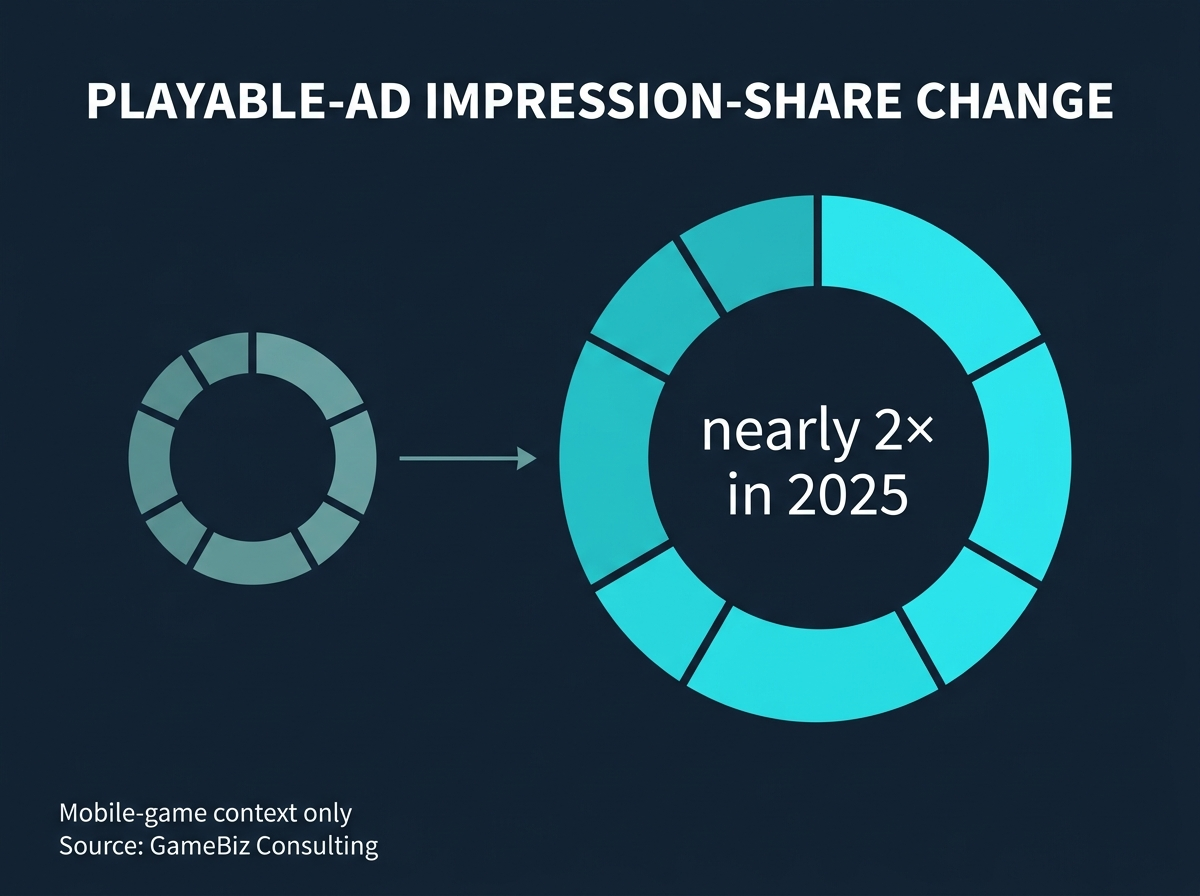
Format choice is also contextual. GameBiz Consulting reports that playable ads' share of mobile-game ad impressions grew by nearly two times in 2025. That statistic applies to the mobile-game context reported by the source, not every app category, and it does not establish that a playable will outperform another format for a particular app or audience. Test the format against a defined message and quality outcome.
Apply AI-assisted segmentation with data-quality and explainability controls
AI in mobile user acquisition can help teams organize signals, generate hypotheses or identify segments for review. It should not be treated as an autonomous growth guarantee. Before using any AI-assisted workflow, confirm what data enters it, which decisions remain human-reviewed, how outputs are evaluated and whether targeting, privacy or automated-decision rules apply in each jurisdiction and platform.
A practical control is to maintain a test log: hypothesis, inputs, creative version, audience definition, measurement window, result and next decision. This makes it easier to distinguish a useful pattern from a correlation created by timing or incomplete data.
How to evaluate a mobile app marketing agency or managed performance partner
The best mobile app marketing services fit the operating gap—not the broadest service menu. Ask a prospective partner to explain its measurement assumptions, channel-selection process, creative-testing cadence, brand-safety controls and reporting format. Clarify which outcomes it can influence, which inputs remain the advertiser's responsibility and how it will surface uncertainty.
A credible mobile app marketing agency should also make collaboration concrete: named owners, approval paths, test frequency and an escalation route when data quality or policy constraints affect the plan. For an advertiser-side view of how a specialist partner can fit this work, see Gadmobe's solutions for advertisers.
Turn the plan into a test-and-optimise operating cadence
Run the programme as a recurring decision loop. Weekly reviews can inspect delivery, creative learning and leading quality signals; less frequent reviews can assess whether the acquisition mix is supporting meaningful in-app behavior. Keep a change log so the team can connect a result to the change that preceded it.
Use cost metrics in context. An install price alone cannot answer whether a campaign is producing valuable users; the trade-off between CPI and CPA depends on the event, the app's maturity and how reliably that event is measured. Gadmobe's guide to CPI versus CPA in mobile advertising can help frame that choice.
When to bring in Gadmobe for mobile user acquisition and performance advertising
Bring in a specialist when the team needs disciplined execution without surrendering strategic clarity. Gadmobe positions its work as channel-neutral, measurement-led mobile performance support: align the acquisition objective, test responsibly, maintain quality controls and use evidence to guide the next iteration. That is distinct from promising a one-platform data advantage or a generic full-service-agency remit.
Start with the app's commercial question, its measurement constraints and the learning that would justify the next investment. A focused operating plan gives any managed partner a better brief—and gives your team a clearer basis for deciding what to scale, revise or stop.