

Mobile app marketers are making budget decisions across fragmented platforms, privacy-preserving signals and competing definitions of success. Measurement therefore needs to move beyond a single dashboard or last-touch view. On February 2, 2026, the IAB announced Project Eidos, a multi-year initiative intended to improve interoperable, privacy-resilient measurement across attribution, incrementality and marketing mix modeling (MMM).
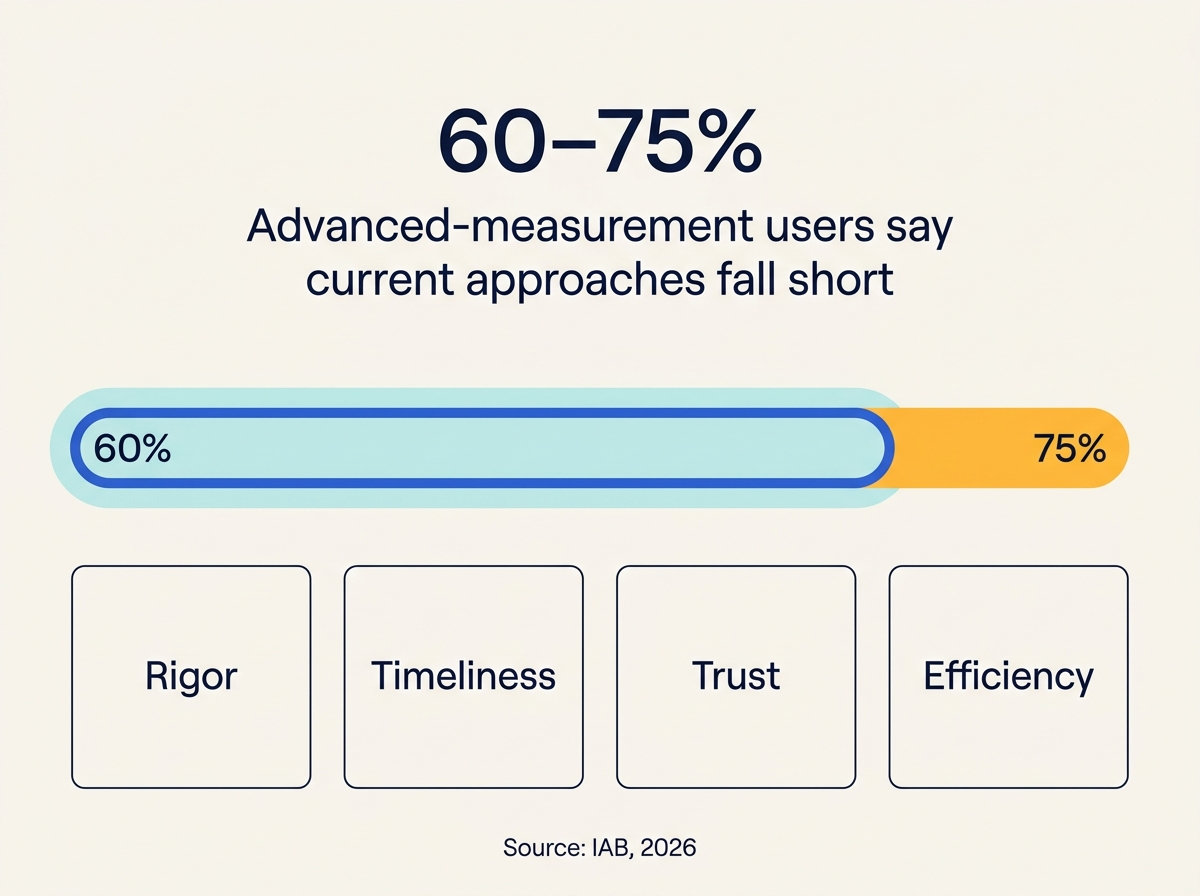
For app growth teams, the practical implication is not “replace attribution.” Give each method a defined job, then reconcile the evidence before reallocating spend. The IAB’s 2026 research surveyed more than 400 senior brand and agency decision-makers with planning or analytics expertise; among advanced-measurement users, 60–75% reported shortfalls in rigor, timeliness, trust or efficiency. That signals a need to improve the operating model; one framework will not solve every measurement problem.
Why Project Eidos matters for app measurement
Project Eidos is a developing industry initiative, not an implemented mandatory standard. It points toward methods working together as signals evolve. On iOS, Apple describes AdAttributionKit as a privacy-preserving way to present ads, update conversion values and receive attribution. Mobile app attribution reporting remains valuable, but may not answer every strategic question about total media impact.
The response is to stop asking one approach to answer every question. Attribution, incrementality and MMM serve different roles: attribution supports fast operational decisions; incrementality tests whether a specific activity caused additional outcomes; and MMM helps leaders assess the combined contribution of media and other factors over time. Each has limits determined by market, platform, available data and methodology.
What marketing mix modeling can—and cannot—answer
Marketing mix modeling estimates how marketing activity and contextual factors relate to outcomes at an aggregate level over time. Google describes MMM as a holistic view across channels and external factors. It can help answer a portfolio question: how should investment across paid channels, organic activity, seasonality and other influences be considered?
That wider lens is useful for mobile app campaign measurement when platform reports point in different directions or leadership needs a planning view beyond individual touchpoints. MMM can frame budget scenarios and identify areas that deserve further testing. It should not be treated as automatic truth, precise user-level credit or proof that a single campaign caused every modeled outcome.
A credible program requires disciplined preparation and review. Google’s Meridian documentation emphasizes data preparation, model-health evaluation and careful interpretation. Suitability varies: an organization needs relevant history, reliable outcome definitions, appropriate controls and people who can challenge the result. No universal spend or data-volume threshold applies to every app marketer.
Attribution, incrementality and MMM: three different jobs
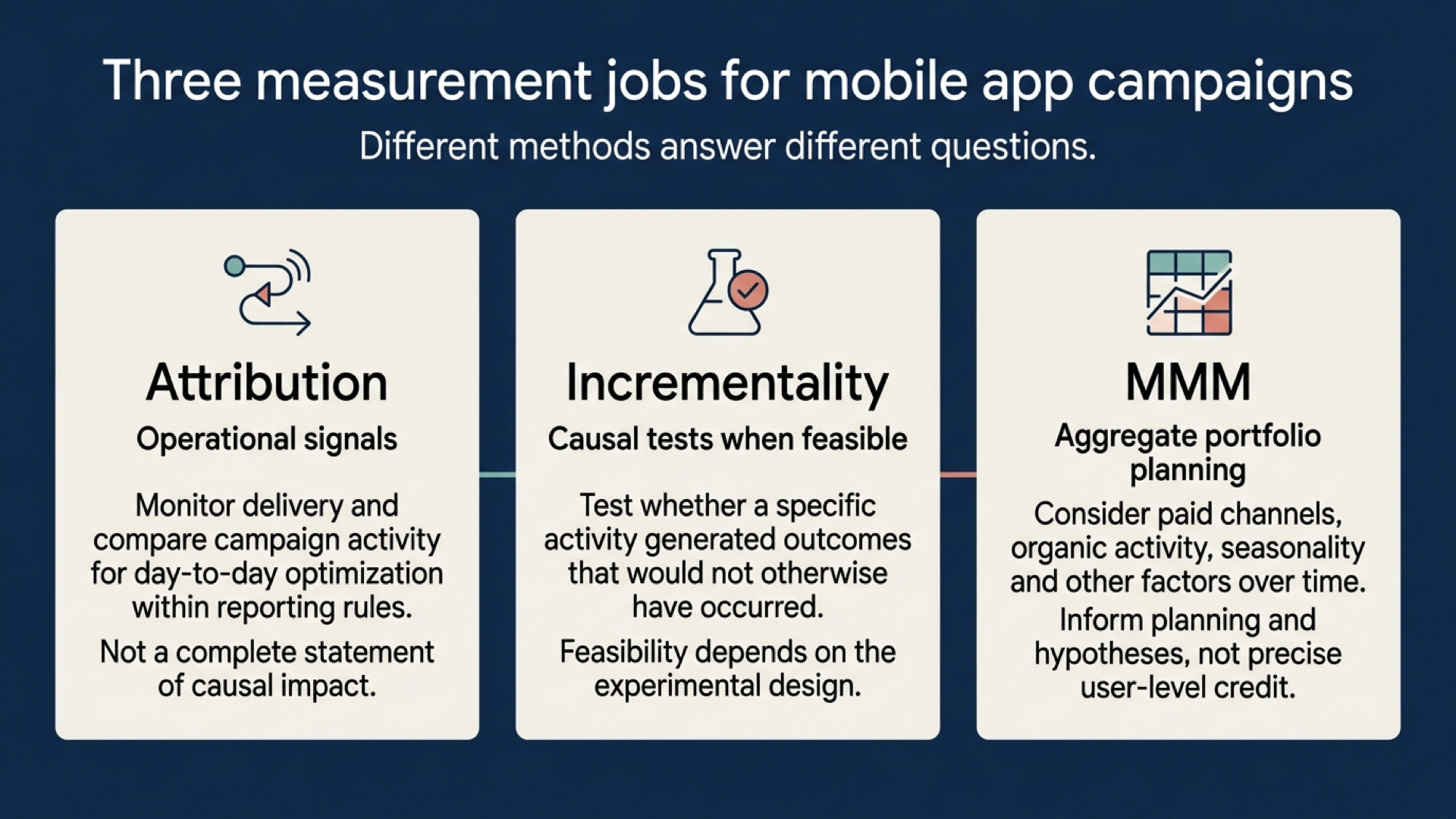
Attribution maps touchpoints and assigns credit under a defined methodology. Use it to monitor delivery, compare campaign activity and make day-to-day optimizations within the reporting rules of a platform or measurement partner. It is an operational signal, not a complete statement of causal impact.
Incrementality testing asks a narrower but decisive question: did a campaign or channel generate outcomes that would not otherwise have occurred? When a sound experiment is feasible, it can provide causal evidence for a specific decision. Feasibility varies. Google notes that eligibility, data strength, study duration, budget, traffic split and conversion setup can affect a Conversion Lift study’s usefulness. Review its guidance on setting up Conversion Lift before promising a test outcome.
MMM brings the portfolio view. Use it to inform planning and surface hypotheses; use incrementality to test priority hypotheses; use attribution to run campaigns and monitor execution. A disagreement is not necessarily an error: it may expose differences in scope, time window, conversion definition or assumptions that need investigation.
A practical operating model for mobile app campaigns
Start with business outcomes, not another reporting tab. Define the app event or revenue outcome that matters, the campaign objective, market and decision the evidence must inform. Document which method will answer which question.
Build a shared evidence calendar covering launches, creative changes, budget shifts, product releases, promotions and major seasonal events. It prevents treating every change in installs or downstream value as a media effect. Keep definitions consistent across internal and platform reporting, while recording differences rather than hiding them.
Sequence work by decision value. Use attribution for in-flight pacing and diagnostics. Reserve incrementality tests for meaningful budget, channel or audience decisions when an experimental design is viable. Review MMM on an agreed cadence for broader planning, with diagnostics and assumptions visible to stakeholders. This is governance, not a software-procurement shortcut.
Gadmobe can support advertisers through mobile app user acquisition and mobile performance advertising, helping teams plan campaigns, organize performance evidence and interpret results against agreed objectives and constraints. Gadmobe need not be positioned as a proprietary MMM software provider for that work to be useful.
Questions to ask a mobile advertising partner
Ask how the partner defines success, which reporting sources it will use and where their limits are. Ask whether a proposed test has the required eligibility and setup, how conflicting signals will be investigated, and who owns the measurement assumptions.
Choose a partner that connects campaign execution to a documented measurement plan. Gadmobe’s advertiser solutions are designed around that commercial need: a clear objective, an accountable activation approach and evidence interpreted with appropriate caution.
The best first step is modest: select one material decision, define the evidence needed and make assumptions reviewable. Marketing mix modeling, attribution and incrementality are most valuable together when they help a mobile app team make a better next decision—not when they claim certainty that the data cannot support.